
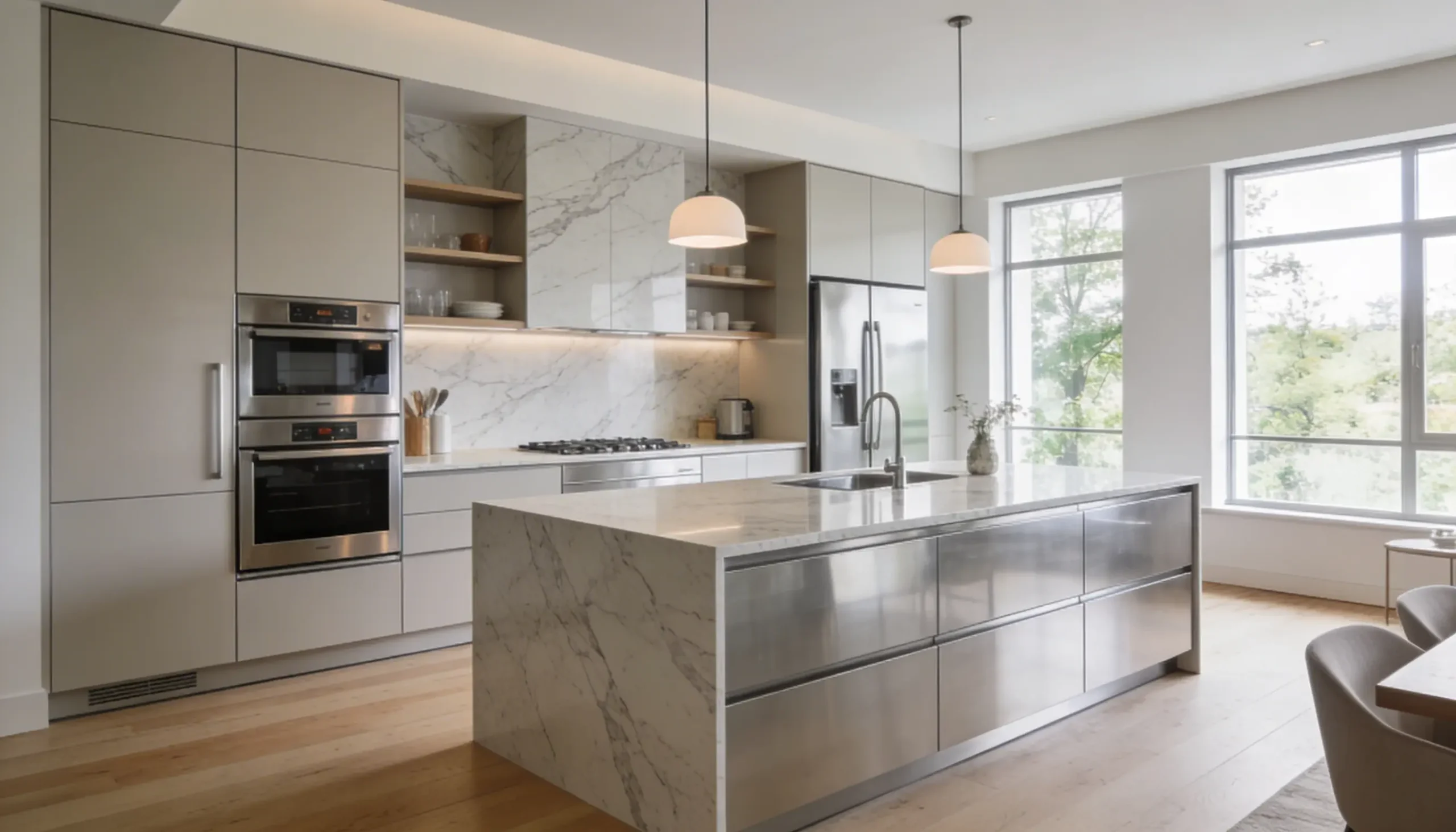
Kitchens are the room in a house that people are most reluctant to leave alone, and the one they most often wish they had approached differently. A well-planned kitchen renovation is crucial, and with this Kitchen Renovation Guide, you’ll navigate key decisions like layout, materials, contractors, permits, appliances, and timing. Because the kitchen is central to daily life, getting it wrong doesn’t just cost money, it costs weeks of disruption, meals eaten out, and the frustration of watching something you paid a lot for not quite work the way you imagined.
Most renovation problems aren’t caused by bad luck. They come from planning gaps that seemed harmless in the early stages, selections made before measurements were confirmed, contractors hired before designs were finalized, budgets built without contingency. The physical work, done properly, is often the most predictable part of the whole project.
What follows is a practical look at how a kitchen renovation actually unfolds: where the real decisions are, what usually goes sideways, how to spend your money well, and what you can realistically handle yourself versus what you should hand to someone licensed and insured.
Planning Your Kitchen Renovation
Start With What’s Actually Wrong
Before looking at a single cabinet door sample or scrolling through tile options, spend time being honest about what your current kitchen fails at. Not aesthetically — functionally. Is there not enough counter space near the stove? Does the layout mean two people can’t be in the room without getting in each other’s way? Is the refrigerator placed so that the door swings into the main walkway?
These questions matter because they determine scope. A kitchen with a functional layout but dated finishes is a very different renovation from one with a layout that genuinely doesn’t work. The first can be transformed with cabinets, countertops, and paint. The second may require moving a wall or relocating a sink, which means permits, structural review, and a significantly larger budget. Conflating the two is how people end up spending $60,000 on a problem that $20,000 could have fixed, or spending $15,000 cosmetically when the underlying issues remain.
Write down three things that actually bother you about your current kitchen. Not three things you’ve seen on design blogs — three things that make your kitchen harder to use or live with. That list becomes your brief.

Layout Decisions That Can’t Be Undone Cheaply
The work triangle — the spatial relationship between your stove, sink, and refrigerator — isn’t a dated design principle. It’s still the clearest framework for whether a kitchen layout will work in practice. When those three points are too far apart, daily cooking becomes physically tiring. When they’re too close or overlapping, two people can’t work simultaneously without constant interference.
Layout changes are among the most expensive decisions in a renovation because they involve plumbing and electrical rough-in work hidden inside walls. Moving a sink three feet to improve the workflow can add $3,000 to $8,000 to a project once you account for new drain lines, supply lines, and the drywall work to close everything back up. That might be completely worth it — or you might achieve a similar result with a better cabinet configuration. The point is to make that call deliberately, not discover it mid-project.
Clearance requirements are easy to overlook in the planning phase but become obvious problems once cabinets are in. You need at least 42 inches between parallel counters for a single cook to work comfortably; 48 inches if two people will use the kitchen simultaneously. Island sizing is particularly prone to optimism — a large island looks proportional on a floor plan and feels obstructive in person if the kitchen can’t genuinely accommodate it.
Permits: The Part People Skip and Regret
Permit requirements vary by municipality, but the general trigger points are consistent: structural work, new electrical circuits, and plumbing line changes almost always require one. That covers a significant portion of what happens in a real kitchen renovation — adding a kitchen island with an outlet, moving the sink, taking down a wall, upgrading the panel to handle a new range.
The immediate risk of skipping permits is a fine. The longer-term risk surfaces during a home sale, when unpermitted work shows up on inspection reports. It becomes a negotiating point that buyers use aggressively, and retroactive permitting on work already inside the walls can mean opening finished surfaces to pass inspection. It’s rarely worth the time saved.
If you’re in a condo or an HOA community, there’s an additional layer of approvals that operate separately from municipal permits. Some associations restrict contractor working hours, require board approval for any work touching common-wall plumbing systems, or have rules about what can be altered. Finding this out after you’ve signed a contract with a contractor is a significant problem. Find it out in the first week of planning.
Kitchen Renovation Budget Ranges
What Renovations Actually Cost in 2026
Kitchen renovation costs have shifted upward over the past few years, partly due to sustained demand, partly due to supply chain pressures on materials that haven’t fully normalized. The ranges below reflect realistic U.S. averages for 2026. Regional variation is real: a mid-range renovation in a high cost-of-living market like the Bay Area or New York will run 30 to 50% higher than the same project in a mid-sized Midwestern city.
| Renovation Tier | Typical Scope | Estimated Cost (US, 2026) |
|---|---|---|
| Basic Refresh | Paint, hardware, fixtures, minor updates | $5,000 – $15,000 |
| Mid-Range | Cabinets, countertops, appliances, flooring | $20,000 – $50,000 |
| Full Renovation | Layout changes, all new finishes, new plumbing/electrical runs | $55,000 – $120,000 |
| Luxury / Custom | Bespoke cabinetry, premium stone, full redesign | $130,000+ |
These tiers exist on a continuum. A project can sit between ranges depending on choices — custom cabinets with standard appliances, or stock cabinets with premium countertops. The tier is determined by the aggregate of decisions, not any single one.

Where the Budget Actually Goes
Understanding how renovation budgets break down by category is more useful than knowing a total number, because it shows where trade-offs are possible and where they aren’t. Cabinets are typically the largest single cost and also one of the most flexible — the difference between stock and semi-custom cabinets can be $10,000 to $20,000 on a mid-size kitchen, with functional results that are nearly identical for most homeowners.
| Category | Typical % of Total Budget | Notes |
|---|---|---|
| Cabinets & Hardware | 25 – 35% | Biggest single cost driver; semi-custom vs. stock makes a large difference |
| Labor | 20 – 30% | GC markup, tradespeople, installation crews |
| Appliances | 15 – 20% | Wide range; integrated vs. freestanding changes costs significantly |
| Countertops | 10 – 15% | Fabrication and installation often separate charges |
| Flooring | 5 – 10% | LVP on the low end; large-format tile on the high end |
| Electrical & Lighting | 5 – 8% | Rises sharply if panel upgrade is needed |
| Plumbing & Fixtures | 4 – 7% | Moving lines adds cost quickly |
| Backsplash & Tile | 3 – 6% | Labor-intensive; grout and setting materials add up |
| Contingency | 10 – 15% | Non-negotiable; always hold this back before starting |
The Costs That Catch People Off Guard
Permit fees are rarely quoted prominently upfront and vary widely — from a few hundred dollars to several thousand depending on scope and municipality. Debris removal and dumpster rental is another line item that surprises people. A full gut renovation generates significant volume; your contractor should include this, but verify it’s in the contract.
The temporary kitchen situation during renovation also has a real cost. If you’re without a functional kitchen for six to ten weeks, you’re eating out most meals. That adds up to several hundred dollars a week for most families — a cost that rarely appears in renovation budgets but absolutely affects the total financial impact of the project.
The contingency fund — typically 10 to 15% of the total project budget — is not optional. Older homes routinely reveal surprises once walls come open: outdated wiring that doesn’t meet current code, water damage that’s been slow-building for years, or plumbing that requires more work than anticipated. A contingency fund is what separates a project that absorbs these discoveries from one that gets derailed by them.
Renovation Timelines and What Actually Causes Delays
Realistic Timeframes
A basic cosmetic refresh — paint, hardware, maybe new fixtures, can be done in two to four weeks. A mid-range renovation involving new cabinets, countertops, and appliances typically runs three to five months from the start of planning to completion. A full gut renovation with layout changes should be planned for five to eight months, sometimes longer.
The construction phase itself is often shorter than people expect. A skilled crew can gut a kitchen and rough-in new work in a week or two. The longer portion is what happens before and after: the planning and selections phase, and the sequencing of finish work that has to happen in a specific order.

The Real Causes of Delays
Material lead times are the most common source of delay that homeowners don’t account for early enough. Custom cabinets currently run eight to sixteen weeks from order to delivery in most markets. Countertop fabrication takes two to four weeks after templating, which can only happen once the cabinets are installed. Certain appliances — particularly professional-grade ranges and integrated refrigerators, have extended lead times or back-order situations that can stretch several months.
The domino effect of a single delayed item is significant. If cabinets arrive two weeks late, countertop templating shifts two weeks. That shifts countertop installation. That shifts appliance installation and plumbing hookup. A two-week cabinet delay can produce a five to six week shift in the overall completion date. The mitigation is to order everything before demolition begins — not after.
Contractor sequencing is the other major source of delay. Trades need to come in a specific order: demolition, rough-in (plumbing, electrical, HVAC), drywall, cabinets, countertops, tile, flooring, finish electrical and plumbing, paint, fixtures. If a subcontractor isn’t available when their phase comes up, the entire sequence stalls. A general contractor who manages their own subs efficiently is worth a premium for exactly this reason.
Change orders — decisions made after work has started. are both a financial and a timeline problem. Every change order adds cost and frequently pushes completion out, because what seems like a small decision often has downstream effects on work that’s already been scheduled or partially completed. The best way to avoid change orders is to finalize every selection before demolition begins. Not most selections — all of them.
Safety Considerations Homeowners Underestimate
Before Demolition Begins
In homes built before 1980, asbestos testing is not optional — it’s a baseline requirement before any demolition work. Asbestos was commonly used in floor tiles, pipe insulation, drywall joint compound, and ceiling textures. Disturbing it without proper testing and, if necessary, abatement by a licensed professional creates serious health exposure and potential legal liability. Test first. It’s inexpensive relative to the alternative.
Lead paint is a parallel concern in older homes. If your kitchen has multiple layers of old paint, testing before sanding or scraping is responsible practice — especially if children or pregnant household members are present. Certified lead abatement contractors exist specifically for this situation.
Utility shutoffs should be confirmed and verified before any demolition work. Not just turned off — confirmed off. Electrical panels should be labeled accurately; many older panels are not. A voltage tester on every outlet and switch before cutting into walls is basic practice, not excessive caution.
Electrical Safety in Kitchen Renovations
Kitchens are among the most electrically demanding rooms in a house. Modern kitchens typically require dedicated 20-amp circuits for the refrigerator, dishwasher, microwave, and garbage disposal, plus the range circuit (which is commonly 240 volts). If your current kitchen was wired decades ago, the panel capacity may not support the addition of modern appliances without an upgrade.
GFCI outlets — the ones with the test and reset buttons — are required by current electrical code near any water source. If your existing outlets near the sink are not GFCI protected, that’s a code violation in most jurisdictions and a genuine safety risk that should be corrected as part of any Kitchen renovation, regardless of scope.
Arc-fault circuit interrupter (AFCI) breakers are increasingly required in kitchen circuits under current codes. Your electrician will know what’s required in your jurisdiction; the point is that electrical work done without permits and inspections may not include these protections, and that matters for both safety and insurance purposes.
Ventilation and Air Quality During Construction
Renovation work generates significant dust, off-gassing from adhesives and sealers, and debris that shouldn’t circulate through the rest of the house. Plastic sheeting between the work zone and occupied areas is a basic containment measure, but it requires proper installation to be effective — not just draped loosely over a doorway.
New cabinets, paints, and sealers emit VOCs (volatile organic compounds) at elevated levels for days to weeks after installation. Running fans, opening windows, and keeping children and pets out of freshly finished spaces during that period is practical advice, not overcaution.
What You Can DIY vs. What Should Be Left to Professionals
The Honest Framework
The DIY question in kitchen renovations isn’t really about what’s physically possible with enough YouTube research. It’s about what’s insurable, what’s code-compliant, and what happens if something goes wrong inside a wall three years from now. Several trades in a kitchen renovation are legally required to be performed by licensed professionals in most jurisdictions — and for good reason.

The table below gives a realistic assessment of task-by-task DIY viability:
| Task | DIY Feasibility | Skill Required | Risk if Done Wrong |
|---|---|---|---|
| Painting walls & cabinets | High | Beginner | Low – cosmetic only |
| Replacing hardware | High | Beginner | Low |
| Tile backsplash | Moderate | Intermediate | Medium – grout lines, adhesion |
| LVP / click-lock flooring | Moderate | Intermediate | Medium – subfloor prep matters |
| Cabinet installation | Low – Moderate | Advanced | High – plumb and level is critical |
| Countertop installation | Low | Advanced | High – templating and seams require precision |
| Appliance installation (basic) | Moderate | Intermediate | Medium – gas lines excluded |
| Plumbing rough-in | Not recommended | Licensed required | Very high – leaks inside walls |
| Electrical circuits / panel | Not recommended | Licensed required | Very high – fire and code risk |
| HVAC / range hood venting | Not recommended | Licensed required | High – ventilation codes are strict |
Where DIY Genuinely Makes Sense
Painting is the clearest DIY win in a kitchen renovation. Cabinet painting in particular, when done with proper preparation — cleaning, degreasing, sanding, priming, and using a finish-grade paint or conversion varnish, produces results that are very close to professional quality at a fraction of the cost. The difference is in the prep time, which most people underestimate.
Hardware replacement is simple and impactful. Changing cabinet pulls and hinges can significantly update the look of existing cabinets without touching the cabinet boxes themselves. Tile backsplash is another area where a homeowner with patience and attention to detail can produce professional-quality results, though grout line consistency and proper substrate preparation are where amateur work tends to show.
Click-lock LVP flooring has made DIY flooring installation more accessible than it used to be. The material itself is forgiving, the tools required are modest, and the learning curve is manageable. The critical variable is subfloor preparation — LVP requires a flat, level substrate. Skipping that step produces a floor that clicks and shifts underfoot within months.
Where Professional Work Is Non-Negotiable
Plumbing rough-in, electrical circuits, and HVAC work should not be DIY projects in a kitchen renovation — not because the skills are necessarily beyond a capable homeowner, but because licensed work on these systems is what your insurance policy depends on and what code inspections verify. A plumbing leak inside a closed wall that develops over eighteen months is not just a repair problem. It’s a potential mold problem, a potential insurance dispute, and a potential disclosure issue when you sell.
Cabinet installation is another area where professional installation pays for itself. Cabinets that are not plumb, level, and properly secured to studs will have doors that don’t align, drawers that stick, and over time can develop structural issues if they’re carrying significant weight. The physical work of installation isn’t beyond a skilled DIYer, but the tolerance for error is very low and the downstream consequences of getting it wrong are significant.
Common Kitchen Renovation Mistakes That Cost Homeowners Money
Starting Construction Before Finalizing All Selections
This is the most predictable and expensive mistake in kitchen renovations, and it happens constantly. The pressure to start — to feel like the project is moving — leads homeowners and even some contractors to begin demolition before countertop material, cabinet style, appliance model, and tile selections are confirmed. Every undecided selection at the start of construction is a potential change order, delay, or mismatch that costs money to resolve.
Countertop material and thickness affects cabinet sizing. Appliance dimensions affect cabinet configuration. Tile layout affects electrical outlet placement. These dependencies mean that a decision made late in the process can require reworking something that was already done. Finalize everything before the first wall comes down.
Choosing the Lowest Bid Without Vetting the Work
Three bids is the standard recommendation, and it’s good advice — but only if you’re comparing equivalent scopes of work. A bid that’s 30% lower than the others isn’t necessarily a bargain. It may reflect a narrower scope, substandard materials, or a contractor who plans to make up the difference through change orders once work has started and you’re committed. Ask each bidder to walk through their bid line by line and explain what’s included and what isn’t.
Licensing, insurance, and references matter more than most homeowners act like they do. A contractor doing $40,000 of work in your home should be able to provide current proof of general liability insurance and workers’ compensation coverage without hesitation. If they can’t, you’re personally liable for injuries on your property.
Budgeting for Visible Items While Skimping on Infrastructure
It’s easy to spend heavily on the things you’ll see every day — stone countertops, statement tile, high-end faucets, and economize on the things hidden inside walls and behind cabinets. That logic has limits. Cheap cabinet boxes with premium door fronts produce cabinets that look good for a few years and deteriorate faster than better-constructed alternatives. Electrical work done at minimum spec leaves no headroom for future needs. Plumbing fittings that are marginally cheaper often have shorter service lives.
Spend on infrastructure first. Premium cabinet hardware and countertop materials reward the investment because they’re handling physical use every day. Bargaining aggressively on the structural and mechanical work to fund visible upgrades is a trade-off that usually reveals itself eventually.
Ignoring the Ceiling and Upper Zone
The space between the tops of upper cabinets and the ceiling is one of the most aesthetically unresolved areas in the average kitchen, and it’s frequently an afterthought. Leaving it as an open gap collects grease and dust. Filling it with crown molding adds cost and complexity. Extending cabinets to the ceiling eliminates the gap but changes the proportion of the room and adds cost. None of these options is wrong — but the choice should be made during design, not discovered during installation.
Lighting is the other ceiling-level decision that gets deferred and then handled as a last-minute compromise. Recessed lighting placement, pendant positioning over an island, and under-cabinet lighting all need to be planned before walls are closed. Running conduit and placing junction boxes costs very little during rough-in. Adding lighting after drywall is finished is expensive and disruptive.
Not Paying Attention to Contract Language
A contract for kitchen renovation work should specify scope, materials (by brand and model where applicable), payment schedule, timeline, and what happens if materials are backordered or work is delayed. Vague language in contracts — ‘similar to samples provided,’ ‘work to be completed in a reasonable timeframe’ — is how disputes begin.
Payment schedules should be tied to milestones, not to arbitrary dates. A typical structure: a modest deposit to secure the contract and order materials, progress payments at defined phases (rough-in complete, cabinets installed, countertops installed), and a final payment held until punch list items are resolved. Never pay the final installment before you’ve done a thorough walkthrough and confirmed all outstanding items are complete.
Making the Decision That Fits Your Actual Situation
The homeowners who come out of kitchen renovations satisfied — not just with how the kitchen looks, but with the process and the financial outcome — tend to share a few characteristics. They defined what they actually needed before hiring anyone. They finished every design decision before demolition started. They held contingency money in reserve and treated it as untouchable until the project was complete. And they spent the most where it would be used the most: cabinet construction quality, countertop durability, and workflow layout.
The ones who struggle are usually not the ones who made bad aesthetic choices. They’re the ones who started too early, trusted too loosely, or economized in the wrong places. A kitchen renovation is a substantial financial commitment in almost any tier — and the difference between a project that runs well and one that runs over budget and behind schedule is almost always traceable to decisions made (or deferred) in the first few weeks of planning.
Before you call the first contractor, you should be able to clearly answer three questions: What functional problems are you actually solving? What is your real budget including contingency? And what are all the selections that need to be finalized before work begins? If those three things are in order, the rest of the project has a foundation to build on. If they’re not, the project will find ways to remind you.
